Showing posts with label Media. Show all posts

Tuesday, September 16, 2014

Can You Stand?

Over the past month I've watched the Sharpe series starring Sean Bean portraying Richard Sharpe, a soldier that rises from the ranks to eventually receive his Lieutenant Colonelcy during the Napoleonic Wars. Sharpe's rise begins by his saving the life of the Duke of Wellington in the first episode. Sharpe is somewhat atypical - he achieves his status in the army by merit, rather than wealth or blood. In an age where most officers were gentry who bought their commissions, this is unusual, and Sharpe needs to deal with the snobbery of the aristocrats throughout his entire career in the series.

Sharpe also deals with questions regarding the choices he makes with women (many of which are poor), and the strong comradeship he has with his friends, particularly Patrick Harper, who becomes the regimental Sergeant Major and saves Sharpe's life more times than can be counted. The bond between Sharpe and Harper is probably closest to Aristotle's idea of a true friendship.

Overall there are very powerful masculine lessons to be gleaned from this series, and I recommend watching it (I haven't read the books yet). However, the most powerful lesson of all came to me from the second episode: Sharpe's Eagle. Let's let Richard Sharpe do the talking from this point (skip to 5:25):


"This place is called Talavera. There's gonna be a battle here tomorrow. You'll fight in it, maybe even die in it. But you won't see it. There's a lot of smoke in a battle. Our cannon, their cannon. Our shot, their shell. Our volleys, their volleys. You don't see a battle, you hear it! Black powder blasting by the ton on all sides. Black smoke blinding you and choking you and making you vomit! And the French come out of the smoke - not in a line, but in a column. And they march towards our thin line. Kettle drums hammering like hell and a golden eagle blazing overhead. They march slowly, it takes them a long time to reach you, and you can't see them in smoke, but you can hear the drums, and they march out of the smoke and you fire a volley, and the front rank of the column falls, and the next rank steps over them with drums hammering, and the column smashes your line like a hammer breaking glass, and Napoleon has won another battle. But if you don't run, if you stand until you can smell the garlic, and fire volley after volley, three rounds a minute, then they slow down. They stop. And then they run away. All you've got to do is stand and fire three rounds a minute! Now you and I know you can fire three rounds a minute, but can you stand?"

Sharpe later tests his men again:


After the incompetent commander Simmerson falls back, Sharpe rallies the troops with this short, decisive speech:

"Now, I know you can fire three rounds a minute, but what I want to know now is - can you stand?"

I think that this quip, and this analogy, works rather well towards life in general. When it comes to overcoming any challenge, it's often not whether you have the skill to do it, but whether you can stand in the grit.

Here's a personal example. A couple of weeks ago, I was coming back home from a stint outside. I did two approaches earlier in the day and got rejected twice. On the way back home I saw a very beautiful girl - one of the best looking girls I'd seen in a while. She's just my kind of girl too. Blonde, beautiful blue eyes, great body. This was on the street, and not doing street approaches often, I was about to pussy out from approaching.

I walk away.

Miraculously, she changes direction to walk down where I'm walking down.

My mind spins. I see her looking around, almost as if she was exploring. I know that when a girl does this she's usually open to a chat. I second-guess myself and tell myself I should approach.

Still, it's the street, and I walk away again.

As she turns once again, I turn back toward her. My mind spins. I third-guess myself.

My mind and I knew that I could approach girls and start conversations with nearly any of them (including on the street). But could I stand?

I turn back and move toward her. I open her and go on an instant date. Although she had to leave the city the next day (I tend to have this sort of luck), I'm still in contact with her, and she's planning to move here in December.

I had the skills, but what was more important here was that I "stood."

Such is often the case. As Sharpe said: "I know you can fire three rounds a minute, but can you stand?"

I know that you can lift this weight. I know that you can pull yourself up this many times. But then you feel the burn and the pain and your body is screaming at you to stop. You and I know that you can push yourself up again, you have the capability - but can you stand?

You can write more than you do now. I know you have the capability to write 2,000 words a day. But can you stand?

And so on.

"Standing" is probably even more important than ability when it comes to success. You can have all the ability in the world and still lack success because you wouldn't stand. You wouldn't bust your ass in the face of adversity and conflict. You'd run away. That was me in a nutshell until last year, and I still have a ways to go with regards to this.

Take somebody that has half the skills though, and can stand every time, and he'll likely be at least moderately successful in any endeavor he wishes to choose.

Whatever it is you fear, or are hesitant to do, stand for one minute. If you can do this, your fear will vanish, and your skills will be brought to bear. If you can just stand for one minute, you've likely gotten it done.

So, I know that you and I can fire three rounds a minute. What I want to know now is - can we stand?

Monday, July 28, 2014

Tucker Max's Childish Shenanigans

Today is the centennial of the outbreak of World War I, and I've begun the first in a series of articles for Showdown of Arms for the coming month that will be centered around this conflict. Much as I am reluctant to take a break from crafting this article, I think it necessary to write this post for the Masculine Epic concerning a recent controversy in the community.

Earlier in the year, Tucker Max, an author (more like a sophomoric frat boy) who has claimed to have success with seducing women, and Geoffrey Miller, a disgraced academic, launched a new website centered around dating advice for men called The Mating Grounds, which I won't link to here because I don't want to give it any hits, as counterintuitive as that may seem since I'm writing about it. Oh well.

The Mating Grounds has caused a lot of controversy. Some like Frost at Thumotic wished it well and hoped that The Mating Grounds would be a good website. Others like Mike at Danger & Play immediately lambasted Tucker Max and The Mating Grounds, claiming that it was a cheap copycat site whose only modus operandi was to ignore or bash the rest of the community, whichever suited Tucker Max better.

I don't like getting involved in controversies like this if it can be avoided, especially online. So I decided to, in the words of Marcus Luttrell, "let the situation develop." However, I now think it imperative of me to make this post. This community has helped me a lot and I do not want to see it undermined by charlatans and opportunists.

When it seemed like Tucker Max and The Mating Grounds were headed firmly toward Mike's prediction: a cheap, watered-down, PC-infested site whose only purpose was to bash others and not tell the whole truth, more controversy ensued.

Now we have something to confirm it once and for all, and which compelled me to lend my voice, however limited it may be, to attacking The Mating Grounds.

In his latest podcast, Tucker Max attacked Roosh. Now, if you want to criticize someone, fine. Plenty have criticized Roosh and I don't agree with everything he says either. However, Tucker outright lied about Roosh in an attempt to damage him. Not only was the lie extremely amateurish because anyone with an IQ above 80 should be able to quickly figure it out, the lie backfired because it only undermined Tucker's own credibility, not Roosh's. Lucky, a member of the Roosh V Forum, posted the transcript here, which I will quote from:

Tucker:

"Exactly! Which, by the way, brings up a super good point. I didn’t know this. Scott Barry Kaufman talked about this. Apparently, one of the really big pick up artists has this book about how he slept with a bunch of women in Russia and he had, like, pictures of them. The whole thing was a lie. The Russian media called this dude out, like, all the pictures he took off, basically, Russian social media sites and all the women freaked out and this dude…he’s still seen as an expert."

Nils:

"He’s so bad that the Russian media did a truth expose?"

Tucker:

"Do you know who I’m talking about? Roosh? That’s who it is, Roosh? So you know what I’m talking about, right? Roosh. Okay, so, whoever Roosh is…"

Nils:

"The Russian media came to the defense of women and the truth…"

Tucker:

"Right?! That’s how fucked up the pick up artist is!"

Nils:

"Wow."

Tucker:

"This dude. His whole thing was a lie! Which is, like…you know, that actually shocked me, because I know how easy it is to hook up with women. It’s not hard to hook up. You don’t need to lie about this. It’s not hard at all. That’s what’s funny. Notice how we haven’t talked about these guys aren’t actually fucking girls. Of course they’re fucking – or at least, I assume. This guy, apparently, is not. But it’s not hard to do this stuff. It’s really not."

Geoff:

"Yeah. If you have no conscience and you go for low-quality girls who are already drunk, yeah. Fine. Whatever."

Firstly, Roosh has never styled himself as a pickup artist, which, while relatively minor, is still a connotation that brings up negative imagery from the Mystery era of game. Pickup artists are associated with using faux tactics as a mask to pick up women. Roosh does not advocate such tactics and repeatedly emphasizes hard work in self-improvement so that you become attractive, not act like you are attractive.

More importantly (and this is absolutely key in destroying Tucker's credibility and why any guy out there should seriously question his competence), Roosh has, to my knowledge, never been to Russia. I have never seen him write posts about Russia describing its women or its culture, which is what he's most known for. The country in question over this misconstrued incident was Ukraine, not Russia.

Tucker here demonstrates that he can't even get his story straight about the countries Roosh was supposedly in, let alone anything else.

Most importantly, Tucker is defaming Roosh. By undermining his credibility and claiming he hasn't slept with any women, he is trying to damage Roosh's primary source of income based on slanderous tales.

And as a last bit of hilarity, Tucker Max and crew again undermine their own credibility by that quip by Nils about "coming to the defense of women and the truth." How feminist of a thing for them to say. They certainly aren't going to run afoul of the PC priesthood with quips like that, which should tell you all you need to know about them by itself. They put women on a pedestal.

Now for the actual truth. The thing in question was Roosh's post about reasons to visit Ukraine. Note that Roosh stated, in bold print, that he did not sleep with any of those girls.

So, Tucker is at best a misguided fool, and at worst a malicious deceiver. To further provide evidence that Tucker has nothing new to add to the conversation and that he is only trying to ride coattails, this image speaks volumes:


Notice how most of it is centered around bashing other guys, not on adding value.

I wonder what, if anything, Mark Manson will have to say regarding the criticisms of his own book and work, which I find very helpful.

It is clear that Tucker is an opportunist looking to break into the community to make money, since his other projects have been on the rocks. He offers nothing valuable or anything which hasn't already been said, and he exists seemingly only to bash other guys to make himself look better.

And if you want more proof that Tucker isn't worth listening to, this is his girlfriend:


For a man that's supposedly slept with over 100 women and is now trying to posture himself as a guru to help other guys, I think he can do better.

Tuesday, April 22, 2014

A Primer on Power

A few days ago I watched parts of an episode of The First Churchills (a series I recommend), and rewatched a scene that is a very good primer on how to be powerful:


Skip to 15:33. King William III meets Lord Marlborough. Some years earlier, Marlborough had raised the specter of public dissatisfaction with the King, who seemed to favor Dutchmen over Englishmen even in the English service. For this, Marlborough was dismissed from all his offices and reached the nadir of his fortunes. Now, the prospect of a return to favor dangles before Marlborough's face.

He remains somewhat stoic, giving a light compliment as part of a joke. William then begins to explore Marlborough's thoughts regarding the Peace of Ryswick. William wishes to know if Marlborough is "capable of looking one hour beyond tomorrow." He probes Marlborough's thoughts regarding the Spanish Succession, and Marlborough answers to his satisfaction, revealing that he has kept a pulse on matters of importance despite his dismissal from court.

In a good sign that he has indeed answered to the King's satisfaction, Marlborough is offered a drink by William. In an even better sign, William tells Marlborough of a still-secret treaty he has made with Louis XIV regarding the Spanish Succession.

William then gets to the point of the meeting: after stating that his and Marlborough's "interests grow closer every day" earlier, he offers to the latter the appointment of being the Duke of Gloucester's governor. This was a very important position, as Prince William, Duke of Gloucester was expected to become King in the future. Marlborough was thus restored to his position on the Privy Council and his rank in the army. He was also told that he would be one of the Lords Justices acting as regent while William was overseas.

Marlborough still expresses a gratitude to the King despite his having asked for none, and further reveals his thoughts on the future. Notice also that Marlborough mirrors William's earlier language when he mentions the words "past infamies," which causes the King to smile. Regarding the future, Marlborough said that he hoped the King's efforts for peace would succeed, but he feared Louis' ambition, and that he would very possibly opportunistically break a treaty when it suited him, and that the King knew this perhaps even better than he.

Marlborough states that the struggle may begin again, and that the King was honorably afraid he would not be up to the task. To help him along in that end, he would pick a delegate to take control in emergency, but was albeit powerless to act without his direct command. Marlborough compliments him again, calling the King a "prudent general."

"Do I read your mind correctly sir?" Marlborough asks.

King William answers in the affirmative by offering Marlborough a tour of the rebuilt palace.

There were a lot of subtleties regarding the wielding of power in this scene. Firstly, Marlborough kept a firm finger on the pulse of things despite his disadvantage. If he had not maintained his awareness, he would not have succeeded here.

Secondly, Marlborough mixes some light compliments with a push, saying that the King was honorably afraid. Flattery is part of being the perfect courtier.

Thirdly, Marlborough knew what William wanted to hear and said it to him. He knew that William's entire life was spent opposing Louis XIV's France, and offered him some comfort that he would be able to continue his life's work. He reflected William's thoughts back at him.

Most importantly, Marlborough demonstrated that he would be able to serve the King's self-interest.

I really should rewatch this largely accurate series after having read The 48 Laws of Power. I'm sure there's a lot of subtleties that I may pick up on now that I may have missed before. Marlborough really knew how to play the game - both political and military, and that's why he's one of the Twenty Men I seek to associate with and emulate.

Saturday, April 12, 2014

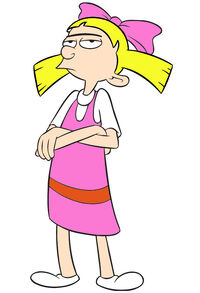
Helga G. Pataki: The Perfect Cartoon Feminist

I'm a 90's kid. I'm sure many others around these parts are. I'm also sure (if you were in the U.S. at least), that you remember a show called Hey Arnold!


The show ran from 1996 to 2004, but was never ended properly. Nevertheless I've been watching it a lot lately, as a bit of nostalgia to reconnect with my childhood. There are generally two major characters in the show: the title character Arnold, and Helga Geraldine Pataki.


Aside from Arnold, Helga receives the most attention in the series, and in fact many of the episodes focusing on Arnold often focus on her too. Sometimes the show could very well be called Hey Helga! and nothing fundamental would change. She is certainly the most interesting and multi-dimensional character on the show. One of the reasons for this is that, as a friend of mine put it: Helga is the perfect feminist.

Helga may sometimes be seen as the antagonist of the show. She's a bully, hits people, is extremely bossy and abrasive, and routinely harasses Arnold in particular. The reason for the latter of course is that she's secretly madly in love with Arnold but is afraid to tell him, and equally afraid of anyone finding out her secret. By constantly bullying him, she hopes to hide that secret.

Helga's demeanor is one of an extreme tomboy, as might be surmised from the above description of her persona. She takes after her blowhard father in both looks and personality. She has been described as "your ugly little friend with the one eyebrow" by Arnold's Grandpa Phil in the episode entitled Grudge Match (Season 4). Even boys are afraid to fight or anger her. Her pink dress and bow act as a sort of ironic costume - her clothing is traditionally feminine, but she is not.

Despite the fact that Helga is essentially the boss of the fourth grade, with the other kids routinely bending to her will, she is far from happy. As we see in the episode Helga on the Chouch (a fan favorite also taking place in Season 4) there are good reasons for her to feel this way. She is the product of an extremely dysfunctional family. Her father, Robert "Big Bob" Pataki is a successful business owner, selling beepers at his store called "Big Bob's Beepers." However, he is extremely self-centered and focuses solely on the things that please him: namely his work and Helga's older sister, Olga.


Helga's mother Miriam is a depressed alcoholic that also routinely neglects her daughter. Miriam is implied to have had much more potential in the episodes Olga Gets Engaged (Season 3), where she mentions that she was an Olympic class swimmer, and The Beeper Queen (Season 4), where she was shown running Big Bob's Beepers better than her husband does, but her marriage has generally made her a shell of a woman.


The Patakis are somewhat interesting in the sense that Miriam can be seen as the perfect feminist victim - a talented woman that gets trapped in a marriage with a successful, but blowhard of a man. However, while she wastes away, Helga to me seems the image of a real feminist: an ugly, angry, broken, bitter woman who lashes out at others to combat her insecurities. On the surface she appears to be what her mother is not (and what feminists say women need to be): assertive, dominant, and in control. Helga is a "strong and empowered woman" or technically, girl. Yet she is just as unhappy as her mother. She is jealous, defensive, and prone to lashing out, particularly at those who make her feel the most insecure: namely, her older sister, Olga.


The relationship between Helga and her sister Olga is one of my favorite aspects of the show. To the casual observer, the two sisters could not be any more different. Helga is deeply jealous of Olga because Olga appears to be everything that Helga is not: beautiful, popular, talented, accomplished, feminine, sweet, and kind. Above all: she receives all of her parent's affection, while Helga is neglected. (Olga does suffer just as much as Helga does, but that's a different topic.)

Olga routinely makes the effort to show kindness and affection toward Helga (essentially trying to give her what her parents rarely do), but Helga tries to sabotage Olga several times throughout the series. Most famously, in Olga Comes Home (Season 1), Helga changed Olga's grade from an A to a B+. This causes a severe breakdown in Olga because she hasn't received a B since the third grade. Helga grins throughout the ordeal, enjoying the fact that she's knocked Olga off her pedestal, but Arnold's entreaties eventually bring her around to changing her mind and admitting that she changed the grade. Similarly in Olga Gets Engaged, Helga tried to go along with letting Olga get married to her con-artist boyfriend, but eventually broke up the wedding when Olga declared that Helga was the best sister she could ask for. All other attempts she makes to sabotage Olga (in Student Teacher (Season 3) and Big Sis) (Season 5) fail, and so she needs to communicate her feelings to her sister in a mature manner.

Rather unwittingly or not, Helga here demonstrates another common trait amongst feminists (and social justice warriors in general): trying to sabotage and bring down beautiful women (or what is beautiful), so they can be made equal with the ugly narcissist, even when the targets of their insecurities are not responsible for any harm. Helga does have potential to be more like her sister (more on that to come), but simply does not make the effort. The result is continued unhappiness.

Despite her social dominance, Helga's personality routinely conflicts with another facet of her nature - one that is kind, sophisticated, and even feminine. Unknown to all but the audience, Helga has a much softer, more affectionate side. She writes poetry (on a good enough level to win contests with) and is the most intelligent student in her class (in the Aptitude Test (Season 3), it is revealed that she received the highest score since her sister Olga took the test, revealing that she is generally just as intelligent as her sister is and that Helga can do whatever she wants in life). These two facets of Helga's personality: the boorish exterior and the soft, sweet interior, conflict with one another throughout the series.

In the episode Helga's Makeover (Season 1), Rhonda Wellington Lloyd, a wealthy girl who is the school's self-proclaimed fashionista, is holding the first of many parties she has at her house throughout the series. It is a girls' party, and all of the girls in her class are invited, except for Helga, who Rhonda considers not sufficiently girlish enough to properly attend.

Later, Helga meets the boys in the class, who are playing baseball. Since Rhonda is having a girl-only party, they explain, they are having a boy-only game. They quickly tease her with a chant of "Helga's not a girl!" Helga responds as she usually does: with aggression. She chases Harold and threatens to beat him up. Watching the chase, even Arnold, far and away the most sympathetic and understanding character on the show, stresses that he is not truly sorry for her.

Helga receives much the same treatment when she spies on the goings-on at Rhonda's house. She finds that Rhonda is imitating her blowhard demeanor, and all of the girls, even her best friend Phoebe, are laughing. When Helga says that she "ought to deck e'm all!" outside, she finds that she is behaving in the exact same way that Rhonda and the others are currently mocking.

It is in this episode that Helga betrays an inner desire to be and act more feminine, and also a quip that gives an insight into her more sophisticated nature. When she finds Phoebe laughing at her she responds "e'tu, Phobebe?" This line of course mirrors Shakespeare's in Julius Caesar, when Caesar is aghast that Brutus has betrayed him. This is something that a nine-year-old shouldn't be smart or sophisticated enough to say, but nonetheless Helga does.

Helga does look more feminine in this episode, but she overdoes it, becoming a caricature to the viewer (if not to Rhonda and the others themselves).

The same friend of mine says that Hey Arnold! is rife with Cultural Marxism, and looking at this episode it would be hard to disbelieve him. It is a not-so-subtle assault (to the trained senses) on that favorite feminist boogeyman: the gender binary.

But if Cultural Marxism is present in Hey Arnold!, the show also shows the inner unhappiness of those who espouse it, with Helga being the best example.

Back to Helga, then. Helga has an inner desire to be feminine (one which she openly admits) in Helga's Masquerade (Season 5), wherein she is offered pointers by Lila, a pretty, popular, and refined girl who is well-liked by boys (including Arnold, much to Helga's chagrin), but she never follows through with it, whether that be in Helga's Masquerade or elsewhere. She always reverts to her same self, never truly improving or even desiring to improve, a trait commonly seen in feminists and other social justice warriors.

This is painfully ironic because, whenever Helga acts the least bit feminine and sophisticated (except for in Helga's Makeover where she was posing and not being genuine), she is successful in achieving her grandest desire: Arnold's attention and affections. However, this never happens directly. It is an allegory for Helga's masked potential that she does not let come out throughout the series.

We see this in Helga's Masquerade, where Helga dresses and acts like Lila, receiving Arnold's affection. It is also present in Arnold's Valentine (Season 1), where she poses as Arnold's French pen pal, Cecile. The closest this aspect of Helga comes to being reality is in Arnold Visits Arnie (Season 5), wherein Arnold dreams he visits his weird cousin Arnie and all that he knows is turned on its head. The result is that Helga has become Hilda, a kind, feminine, sophisticated girl that recites poetry. This is in fact the hidden side of Helga's personality that Arnold does not get to see, and he is immediately attracted to it. It is just another example of what could have been...if Helga made the effort.


Ultimately I find the character of Helga Pataki to be a cautionary one. She comes from a broken background, but many a true champion in life has as well. We cannot control the circumstances of our birth, nor the actions of others if they are unwilling to change. How you decide to deal with your situation is ultimately your choice.

Law 25 of Power: Recreate Yourself.

The character you seem to have been born with is not necessarily who you are. Beyond the characteristics you have inherited, your parents and peers have helped shape your personality. The Promethean task of the powerful is to take control of this process, to stop allowing others to limit and mold them. Remake yourself into a character of power. Working on yourself like clay should be one of your greatest and most pleasurable life tasks. It makes you in essence an artist creating yourself.

This is a quote that I find perfectly applies to Helga, or rather, what she should be doing. The potential is easily there. It is up to her to take control of herself, which she does, but not in the way that produces the outcome that she wants. The most visceral quote that describes Helga best would have to have come from Inge in Helga and the Nanny (Season 3):

You're such an angry girl Helga, and you won't let anyone help you. So you must live with your unhappiness.

Helga does this with nearly anyone that tries to help and be affectionate to her: examples being Inge, Olga, and Arnold, and thus wallows in a deeply-entrenched misery throughout most of the series (the only exception was Dr. Bliss in Helga on the Couch, and this was essentially forced). She has friends, but isn't truly happy with herself, and for the most part, refuses to change. She fits the profile of most feminists. The only thing she doesn't do is play the victim card (which is admirable). If Hey Arnold! is rife with Cultural Marxism, it also shows the ugliness behind the philosophy within it.

The lesson is clear: Law 25 prevails. Do not be a Cultural Marxist. It is poison to the self.

This blog post contains affiliate links.

Tuesday, February 11, 2014

Book Review: Think & Grow Rich

I was fortunate to be able to pick this book up, almost by accident. It was on Roosh's list of recommended books to read and given how much I got out of the 48 Laws of Power, it seemed a no-brainer. The funny bit of trivia regarding this is that I stumbled on the work somewhat by accident (my intention to read it went on the backburner for a bit) through reading several articles on Victor Pride's website, Bold & Determined.

It was an eye-opening read. It gives primacy to the power of thought and ties in well with some of the lessons of the 48 Laws of Power- namely that emotional states are contagious, and you need to be consciously aware of who you are allowing to influence you and what thoughts you allow to enter your head.

More than that, it gives a practical guide to controlling your own thoughts, lays out a blueprint for doing so, and provides a step-by-step philosophy for the mindset of success.

"Thoughts, whether positive or negative, immediately begin to transmute themselves into their physical equivalent."

I thought that was the best quote of the book. It is an old adage that you become what you think about, so you need to be aware of what it is you think about. I would suspect that most people think about nothing, or are too busy thinking negative thoughts, blaming others for their own problems, being miserable. The prevalence of narcissistic 'social justice' ideas gives much evidence to this hypothesis. These thoughts become self-fulfilling prophecies. Excuses for failure are all too common. And this, I would venture to say, is the leading cause of widening income inequality. In the age of the internet, everyone can at least be a part-time capitalist. Everyone has a hobby that can be turned into a moneymaker (and if someone doesn't that says a lot about him, first and foremost, that he needs to find one).

I've stated before that one of my own weaknesses is that I'm very self-critical, too much so. I'm a perfectionist. If things don't go exactly my way, I tend to get frustrated, which leads to negative thoughts that then translate into their physical equivalent. Perfectionism is good in moderation, but I have it too much. Think & Grow Rich allowed me to more fully see this weakness.

It also allowed me to more fully analyze my goals. Think about your goals. Start to make moves toward them. Make them specific. I need to apply the principles of autosuggestion more stringently, to overcome any negative coding in the subconscious mind (another useful aspect of this book).

One of the most amazing things was when Napoleon Hill talked about his imaginary 'Master Mind' council of figures he admired. It was so startlingly similar to my own Twenty Men exercise that I thought I might as well just be plagiarizing him. I guess there's nothing new under the sun. He took it further though. He actively imagined himself sitting with those men he admired and talking with them. That's something I'll need to do myself.

Though I admittedly found some of it a bit hokey, stuff that might as well be proto-New Age mumbo jumbo, the core philosophy is golden, and every man should read this book.

Read or download Think & Grow Rich here. Think & Grow Rich Napoleon Hill Self-Improvement